
Real-Time Media Monitoring: Why Integrated News and Social Media Insights Are Essential for Brand Reputation and PR Analytics
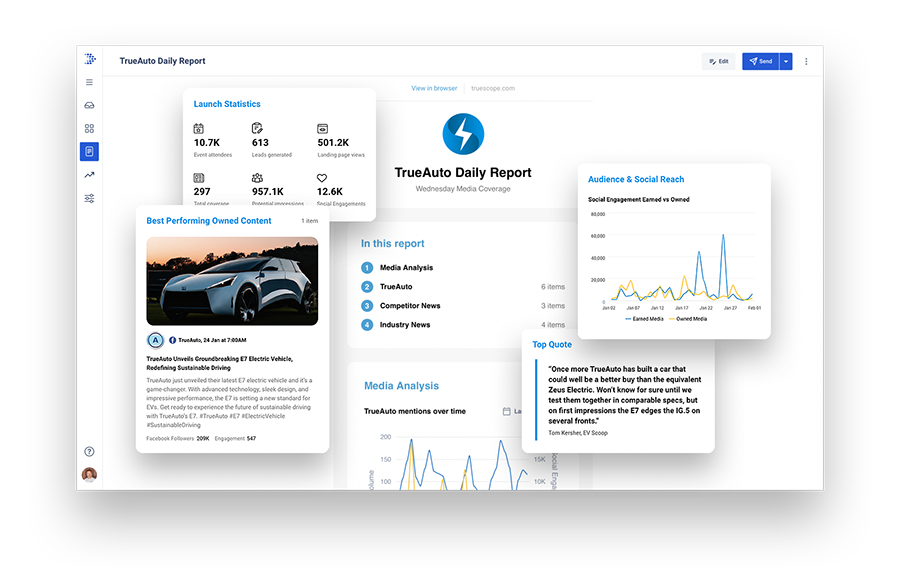

Real-time media insights is the continuous, analysis of mainstream and social channels that reveal emerging narratives, sentiment shifts, and engagement patterns as they happen. By ingesting online news, newswire feeds, broadcast transcripts, podcasts, blogs, forums, and social posts into unified analytics, organizations gain the signal processing that enables faster decision-making and concrete reputation protection.
This article explains what counts as "real time," how cross-channel integration improves PR analytics, and why unified media intelligence is essential for brand reputation in 2025. Readers will learn technical approaches for sentiment and emotion detection, operational playbooks for crisis detection and campaign optimization, and practical selection criteria for monitoring solutions such as real-time dashboards and unified listening platforms. We begin with a clear definition and immediate benefits, then move through integration advantages, sentiment techniques, campaign KPIs, competitor and trend analysis, and finally implementable best practices that emphasize data quality, governance, and explainable AI. Throughout, the focus is on actionable guidance that links analytic outputs to measurable PR outcomes and ethical monitoring practices.
In today’s fast-paced digital landscape, real-time media insights provide organizations with a competitive edge by offering continuous analysis of both mainstream and social channels. This process involves gathering information from millions of sources. The main objective is to uncover emerging narratives, sentiment shifts, and engagement patterns as they occur. By employing signal processing techniques, businesses can make informed decisions swiftly, enabling them to protect their reputation proactively.
Furthermore, the integration of cross-channel data enhances Public Relations (PR) analytics by creating a unified media intelligence framework. In this blog, we will explore the benefits of such integration and discuss various technical approaches to detecting sentiment and emotion in the media landscape. We will also outline operational playbooks that assist organizations in crisis detection and campaign optimization.
Readers will learn about key performance indicators (KPIs) for campaigns, how to conduct competitor and trend analysis, and the essential selection criteria for effective monitoring solutions, such as real-time dashboards and unified listening platforms. By emphasizing data quality, governance, and explainable AI, we aim to offer actionable guidance that aligns analytic outputs with measurable PR outcomes and ethical monitoring practices, positioning brands to navigate the challenges of 2025 and beyond.
What Are Real-Time Media Insights and Why Do They Matter?
Real-time media insights are continuous analytics pipelines that surface mentions, sentiment shifts, and topical clusters within minutes or seconds of publication, enabling teams to act before narratives escalate. This capability works by combining low-latency ingest (APIs, streaming feeds) with fast processing (modern NLP, anomaly detection) to produce immediate signals such as volume spikes, sentiment deltas, and influencer amplification. The result is clear business value: faster crisis detection, opportunistic engagement, and data-driven PR decisions that reduce reputational impact. Immediate detection reduces time-to-decision and converts raw mentions into prioritized alerts for communications teams, which in turn shortens escalation cycles. To illustrate the benefits concretely, the next subsection defines the operational boundaries between mainstream and social monitoring and how their signals differ.
Real-time dashboards and unified listening platforms typically implement threshold-based spike alerts and visual timelines so teams can move from signal detection to action quickly, and understanding these solution types clarifies implementation choices. This leads directly into how mainstream and social sources are defined operationally and how their characteristics combine to form useful real-time insights.
How Is Real-Time Media Monitoring Defined Across Mainstream and Social Media?
Real-time media monitoring spans structured mainstream feeds (newswire, TV/radio transcripts, print) and high-velocity social sources (microblogs, public groups, comments) that differ in latency, structure, and signal type. Mainstream sources generally offer lower volume but higher editorial trust and clearer attribution, while social sources provide massive volume, rapid velocity, and rich engagement signals that surface early trends. Practically, mainstream feeds arrive in discrete articles or transcripts with stable metadata, whereas social data is sparse, often noisy, and requires entity resolution and de-duplication. Combining these sources requires normalization—mapping mentions, timestamps, and entities so volume, sentiment score, and influencer reach can be compared across channels. Understanding these differences helps prioritize alerts and informs analytic weighting when detecting emerging narratives.
Why Is Instantaneous Data Critical for Modern Brand Reputation and PR Strategy?
Instantaneous data shortens the detection-to-response window so teams can mitigate false information, engage supportive voices, or amplify corrective messaging before a story peaks. Early warning—measured as reduced time-to-detect—directly correlates with lower negative reach and smaller sentiment delta during critical incidents. In practice, a minutes-to-hours advantage enables targeted outreach to journalists, rapid Q&A updates, and coordinated social posts that blunt escalation. Organizations that operationalize rapid alerts and decision playbooks minimize misattribution and prevent avoidable reputational damage. The importance of speed also shapes how monitoring systems are conpd—alert thresholds, escalation rules, and validation steps—which we cover later in implementation best practices.
Different configurations of alert sensitivity and human validation determine how many true positives versus false positives teams receive, and balancing those settings is key to effective real-time response.
How Does Integrated Mainstream and Social Media Monitoring Enhance PR Analytics?
Integrated monitoring produces richer PR analytics by aligning diverse signals—reach, trust, sentiment, and engagement—into a single analytical layer that improves attribution and trend confidence. When data from news outlets, broadcast, and social platforms are correlated, analysts can identify whether social amplification follows mainstream reporting or vice versa, improving causal inference and campaign attribution. Integration also enables cross-validation: a sentiment spike on social paired with increased mainstream coverage signals higher confidence than either signal alone. This combined view supports more accurate share-of-voice calculations, refined audience segmentation, and better ROI estimation for PR spend. Below is a focused comparison of typical attributes for mainstream and social sources, showing how they complement one another for PR analytics.
Media source comparison and why each attribute matters for integrated analytics.